This is one of a series of web pages which record the history of Civil Service (Whitehall) Reform from the 1700s through to the present day. A full list can be found here.
This note summarises developments from January 2026 until the end of the Keir Starmer government.
Cabinet Secretary Fired
Cabinet Secretary Chris Wormald was sacked in February 2026 and replaced by Antonia Romeo.
It was never entirely clear why Sir Chris had been sacked. It had been reported in July 2025 that Prime Minister Sir Keir Starmer and his political aides had "buyer's remorse" over their choice of Wormald as the Cabinet Secretary due to him being perceived as too entrenched in the status quo to deliver radical reform. But he eventually went amid the furore following discovery of US Ambassador Lord (Peter) Mandelson's deeper than admitted links with paedophile Jeffrey Epstein. Morgan McSweeney, the PM's Chief of Staff left office on 8 February and Sir Chris followed him on the 12th.
Here is a blog that I published at the time:
>>>>>>
I am not sure anyone can make total sense of what happened in Whitehall in recent days, but let me try to add some context and clarification - ending with yesterday’s attack on (future Cabinet Secretary?) Antonia Romeo,
I draw as far as possible of the writing of commentators much better informed than I am.
Let’s begin by observing that ...
1. We have not been learning about ‘the scandal of the century’.
I agree with Ian Dunt:
This is, as many people are saying, probably the worst scandal of Starmer’s government. But it is not, as many people are also saying, ‘the scandal of the century’. ... You want a scandal? [Covid was] a scandal. That’s about as big a scandal as it is possible to conceive, of thousands of deaths due to government incompetence, of the universal removal of liberty due to government negligence. ...
Any given week of Johnson’s administration brought a scandal far in excess of what we saw here - from unlawfully proroguing parliament, to gutting the country through Brexit, to lying about the customs impact on Northern Ireland, to mutilating the trading integrity of the UK, to breaking his own rules during the pandemic, to the corruption over health equipment, to trying to gut the system for parliamentary standards to save his own MPs.
2. The Mandelson-related criticism of Keir Starmer is hypocritical.
Here’s Lewis Goodall:
I wrote at the end of last week about the hypocrisy of the Mandelson affair. I noted how, the Financial Times aside, I could barely find a scrap of Fleet Street copy objecting to the appointment on the basis of his links to Epstein, which were known to all. Since then I’ve checked Hansard. Imagine my surprise to learn that not a single MP rose in the House of Commons to object to the Mandelson appointment on those grounds. Indeed, as far as I can see, there are only two references - in any Select Committee or parliamentary moment about Epstein - in either House between 2022 and September 2025, when the first of the files dropped. Starmer is judged for looking the other way - yet so did Parliament.
And normal civil service vetting processes were hardly likely to uncover the betrayal involved in the passing of secret information to Epstein by a Privy Councillor and former First Secretary of State (i.e. Deputy Prime Minister).
If you are not familiar with DV vetting then this Substack describes this “limited, flawed, untransparent, incompetent, inadequate and crying out for reform” process.
3. The real reasons for the attack on the Prime Minister are Labour Party internal arguments, and his/its disastrous polling.
You may have missed them - I almost did - but there have been a couple of post-Mandelson references to Fraud - an amazing book by Paul Holden. Here is its back cover blurb:
A sensational investigative expose of the manipulations and machinations that helped bring Sir Keir Starmer to power.
Based on Labour Party files, including some never seen before, The Fraud reveals Starmer as the front man for a ruthless, right-wing political project headed by Morgan McSweeney. McSweeney’s clique often employed dirty tricks to undermine the left-wing labour leadership of Jeremy Corbyn, helped Starmer become his successor on false pretences, then purged their opponents - all made possible by donations that McSweeney unlawfully failed to disclose.
This is a sordid tale that includes hacked emails anonymous smears dodgy dossiers cynical stitch ups and staggering hypocrisy. It traces the Labour Party’s transformation into a sensorial authoritarian machine and sounds the alarm about the possible corruption of British democracy by dark money.
I have no idea whether the accusations in the book are fairly presented, but they are well-documented. So the book itself is, at the very least, clear evidence of a near civil war and associated hatreds within the Labour Party which in turn form important background to the defenestration of Mr McSweeney.
And it’s not hard to find current evidence of the continuing conflict. Iain MacWhirter:
The Battle of the Boys Club is over; the War for Labour’s Soul begins
A resolution of the historic rivalry between left and right cannot be delayed any longer - there will be blood ... It seems that Prime Minister now agrees that all that capitalist boosterism and growth stuff is old hat. It has gone into the bin along with being tough on immigration and sucking up to Donald Trump. A new Keir has emerged, phoenix-like, from the ashes of the Epstein- Mandelson conflagration — more inclusive, more socially concerned, more feminist.
And then there are the polls. Here’s ‘Indy’ on BlueSky:
The tone mismatch between the way they talk about Morgan McSweeney and the facts of (a) Labour polling around 19% average and (b) Starmer at -50 is very disorienting.
And Stephen Bush:
People keep talking about ‘the soft left this’, ‘his rivals in Downing St that’. No! It’s not the soft left on the backbenches or the Blairites in the Cabinet or No.10. It’s the alliance of MPs who can count and would like to remain MPs.
4. Keir Starmer is not the first Prime Minister who has found it difficult to manage the gear shift that is needed on coming into power.
I haven’t noticed many politicians ‘campaigning in poetry’ in recent years. But many of their campaign headlines (small boats, woke, waste, civil service numbers, red tape) are virtually irrelevant when it comes to governing in prose and tackling issues and problems such as climate change, the NHS, Ukraine, the defence budget, adult social care, local government funding etc. etc.
Their political advisers don’t help much, fixated as they often are by media handling, internal party politics or their own obsessions such as Dominic Cummings’ hatred of the Cabinet Office. (It would be easy to abolish it but most (all?) of its functions would still need to be carried out somewhere.)
Government is near-impossible unless loyal MPs and the government machine are given a reasonably clear sense of direction and the Prime Minister and those around them act decisively when policies appear to be in conflict with one another.
David Henig:
A reminder that names will continue to change with regularity in UK politics until leaders realise that there are no easy solutions and that difficult choices have to be made and justified.
Martin Greenaway:
I think the Starmer front bench has policies, but I just don’t think anyone is orchestrating them in a cohesive direction, so you’ve got e.g. Mahmood, Reeves, Miliband all heading off in their own directions, hamstringing each other.
5. Many Prime Ministers, including Keir Starmer, find it difficult to create an effective ‘Centre’.
It is very hard for a Prime Minister to dominate and drive activity across a ‘first amongst equals’ Cabinet Government, as distinct from presidential government.
Prime Ministers were traditionally supported by (and often challenged by) three key individuals:
- ·an exceptionally strong and experienced Cabinet Secretary,
- ·a respected, experienced and powerful Director of Communications, and
- ·a Principal Private Secretary overseeing communications within government
- - all with high quality supporters, of course.
This quartet was effective when Cabinet Ministers were strong individuals who were broadly happy with the government’s strategy. But no-one, and in particular none of the above individuals, were responsible for managing activity across Whitehall. Progress slowed to a crawl, or to a dead stop, when the Cabinet was divided and departments were at loggerheads. This problem was never entirely dormant but grew to be huge as the Tory Party was riven over policy towards the EU and the Labour Party divided, as we saw above, between its left and right wings.
No Prime Minister has yet explicitly abandoned Cabinet government but all have tried various mechanisms in order to improve coordination.
One way to improve coordination and add energy was to add Policy Units, Delivery Units etc. to No.10. These often worked well for a while - but not for ever - depending on personalities, and coming in and out of favour as Prime Ministers came and went.
A number of Prime Ministers have appointed Chiefs of Staff or similar, whose responsibilities varied considerably and often conflicted with the three key individuals mentioned above. Jonathan Powell, Ed Llewellyn, Gavin Barwell and Liam Booth-Smith seem to have worked well within existing structures, and kept well away from the limelight. Nick Timothy, Fiona Hill, Steve Hilton, Dominic Cummings, Dan Rosenfield, Sue Gray, Morgan McSweeney? They were definitely not so successful. They were hopeless managers (and so failed to improve cross-Whitehall coordination) and attracted much unwelcome attention.
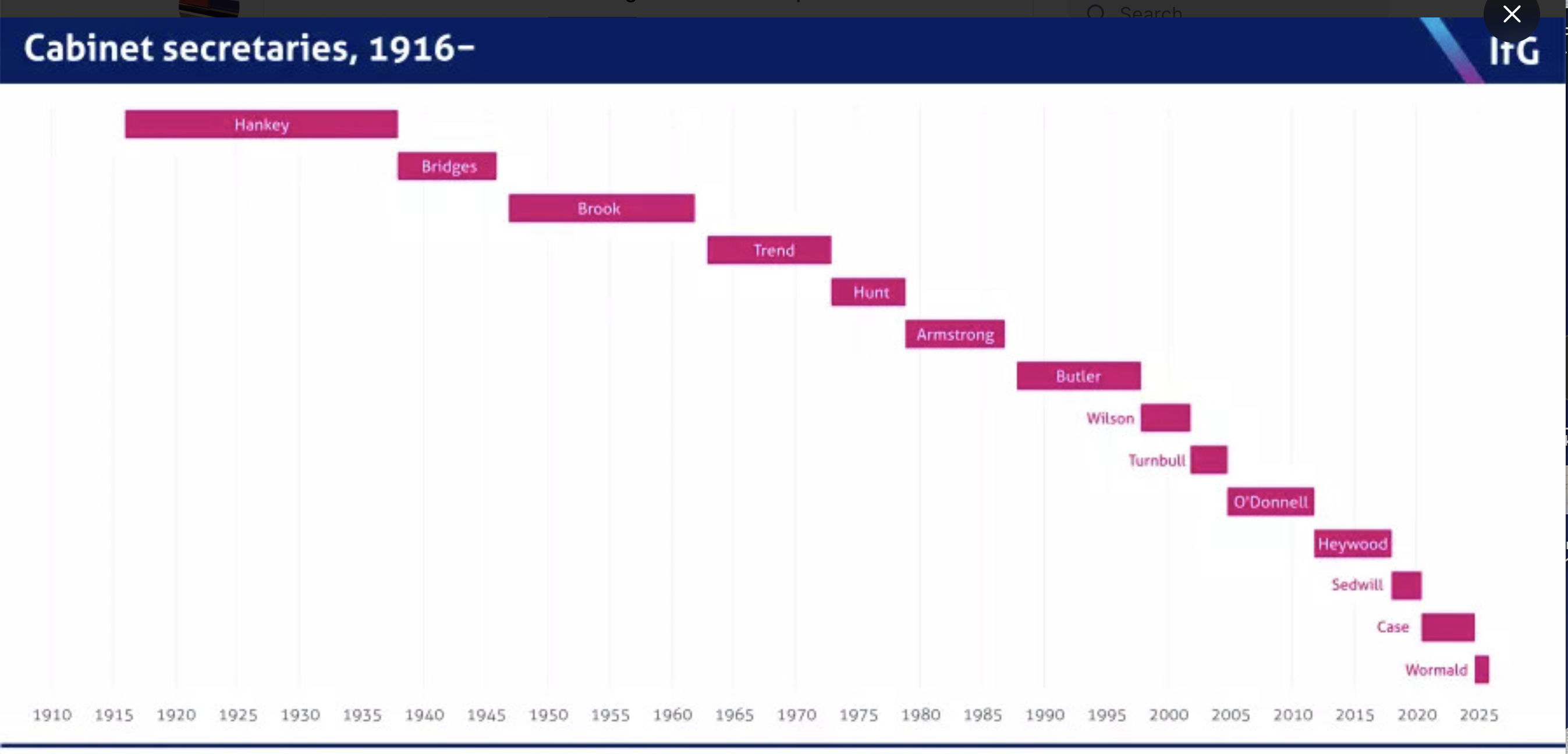
Weirdly, however, recent Prime Ministers have substantially devalued the role of Cabinet Secretary, so exacerbating the problem that is built into Cabinet government. The last four Cabinet Secretaries, in particular, have had less senior and/or relevant experience than their predecessors and appear to have been chosen mainly on the basis of their compatibility with the Prime Minister that appointed them. It is a bit unkind to characterise them all as ‘courtiers’, but that criticism hasn’t been far off the mark.
This wonderful Institute for Government chart shows how terms of office have shrunk. Turnbull, Sedwill and Wormald were surely not given enough time to learn all the elements of a very difficult job.
6. But there is serious opposition to the mooted appointment of Antonia Romeo.
And so we come to the likely appointment of Antonia Romeo as Chris Wormald’s successor. But she is not 100% popular within Whitehall. Here are some extracts from a Times article published on 7 October 2022.
[She is said to be] unapologetically ambitious ... massive self publicist ... Some civil servants describe her as someone so focused on managing upwards that subordinates are never sure if they are about to be sacrificed to please those above her. ... [When appointed New York Consul-General] Romeo used the residence on East 51st Street to host lavish events. ... While decidedly different from her “white, pale, male and stale” predecessors, Romeo’s direct style and penchant for luxury irked her new colleagues in New York. One described how the diplomat was “obsessed” with her social media presence, using her profile on Twitter and Instagram to share pictures of herself with celebrities and public figures.
A junior member of staff resigned while Romeo was in post, telling human resources that she treated underlings “like stepping stones” and was overtly concerned with “building the personal brand of Antonia”. Others counter that her social media efforts only began when she became a diplomat charged with promoting Britain in the US.
She also rubbed some senior colleagues up the wrong way. “Her approach was very much, ‘I want this, I am going to be a permanent secretary, I have got strong backers and you will do what I say if you know what’s good for you’,” claimed one.
During her tenure multiple Foreign Office staff raised concerns about Romeo, who was subsequently investigated for bullying and misusing expenses. In documents seen by The Times, colleagues outlined concerns about how she had requested more than $100,000 to redecorate the residence. When her efforts were rebuffed, she allegedly asked staff to approach British companies, such as Farrow & Ball and The Rug Company, to redecorate it free of charge. Concerns were also raised about her use of $150,000 on school fees for her children, as well as sending $200 bouquets of flowers to figures such as Victoria Beckham.
When the complaints were handed to the Foreign Office in London, Sir Tim Hitchens, the former ambassador to Japan, was asked to investigate. His concerns were passed to the Cabinet Office, which decided that there was “no case to answer”. Some senior Foreign Office officials regarded the decision as a “whitewash” organised by [then Cabinet Secretary and Romeo mentor] Heywood. But a government spokesman said the bullying allegations and complaints over her expenses had come from “a single grievance from a former employee, which was independently dismissed years ago”. Romeo has denied bullying.
These criticisms were aired again last night by Simon McDonald the Foreign Office’s Permanent Secretary 2015-20 who was interviewed by Channel 4’s Krishnan Guru-Murthy.
I think it’s extraordinary! This Prime Minister chose this Cabinet Secretary exactly 14 months ago. It’s usual for Cabinet Secretaries to serve several Prime Ministers (and about a decade) so this is an extraordinary development. ... It feels more likely that the relationship between the Prime Minister and his choice has broken down.
Q. What should happen now? - because it appears the press have all been briefed that he’s already decided who he wants and it’s Antonia Romeo and there’s not going to be a process that aren’t going to be interviews.
What should happen next is very clear. There should be a full process. This is the most important job in the civil service. It can’t be chosen on the fly. It can’t be chosen using a process that is more than one year old. If the Prime Minister wants a new Cabinet Secretary he needs to start from scratch.
Q. How how do they need to probe through these candidates all given the mistakes of not looking too far into people’s backgrounds before?
Due diligence is vitally important. The Prime Minister has recent bitter experience of doing the due diligence too late. It would be an unnecessary tragedy to repeat that mistake.
Q. They’re saying she’s already been approved as suitable for this job so why do anymore process?
I repeat the due diligence needs to be thorough. If the candidate mentioned in the media is the one, in my view that due diligence has some way still to go.
Q. Well that that takes me to the fact that she was investigated when she was working for the Foreign Office when you were running the Foreign Office are you saying they need to go back to that process?
Yes I would prefer to go into detail with the team in No.10 rather than your viewership but yes I am available to talk about that and would like to do that. Sometimes appealing through the media is more effective than doing it direct, which I’ve tried to do but they know how to get hold of me.
Q. Are you saying you’ve tried to warn them?
I’m saying I’ve tried I’ve been in touch today and not had a response.
Q. What do you make of the way that this government is making its appointments overall?
I think that the issue of the Prime Minister’s judgement is the focus like never before. This appointment is vital to him and the country. It is vital he gets it right and it’s vital in my view that he follows proper process.
One final fascinating fact:- It was the very same Simon McDonald whose concerns were ignored by No.10 back in 2022 and who then went to the media and triggered the end of Boris Johnson’s premiership. This story is here.
>>>>>>>
Mandarin Praised
The very public pre-appointment criticism of Dame Antonia, summarised above, was countered by this letter in the Times, signed by all former living Cabinet Secretaries:
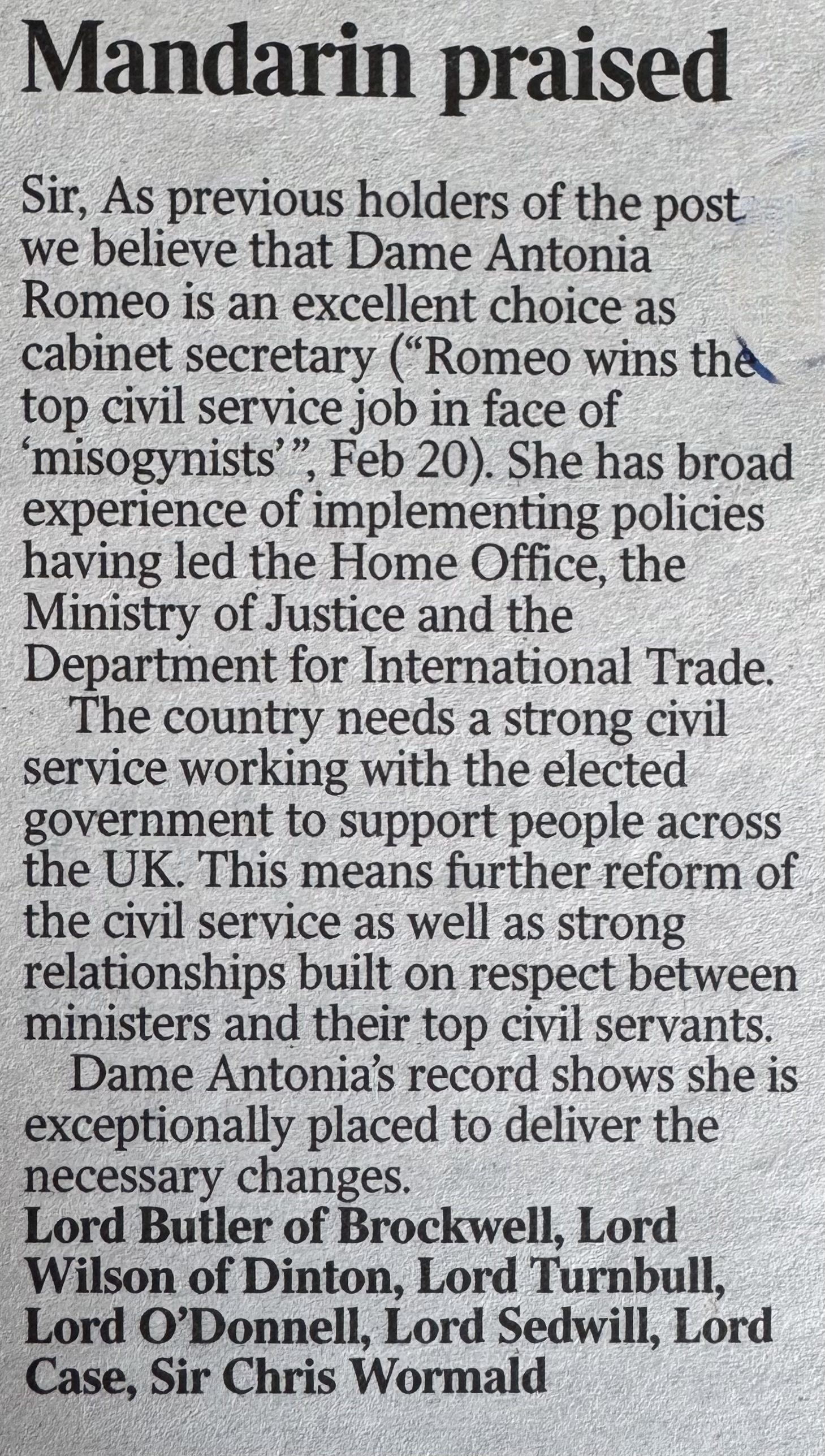
Sir Chris (not yet - and maybe never? - a Lord) must have signed it whilst gritting his teeth. And someone - one wonders who? - must have persuaded all the others to sign a rather obvious snub to their fellow Lord, Simon McDonald.
Dame Antonia's Objectives
Dame Antonia published two interesting and attractive blogs soon after her appointment in February 2026. One was an initial message to 'colleagues' - that is all staff. The second paid tribute to all former and current female Permanent Secretaries. You can read them here.
She then published her objectives in April 2026. I commented as follows:
I must admit that I initially responded rather negatively to the new Cabinet Secretary’s objectives, published a few days ago. (You can read them here.) I thought they looked more like a job description than objectives.
But, although that criticism is valid, I can see what she was trying to say and welcome it, subject to a couple of concerns - see further below.
What do I like?
The tone, for a start. There is a real sense of energy and ambition.
And there’s no nonsense about ‘Civil Service Reform’. She aims to build on established good practice and process.
Here are some of Dame Antonia’s phrases etc. that struck me as particularly welcome. I have emphasised and comment below on some of them.
1. Setting clear expectations and supporting high performance, to drive execution and impact. Visibly lead the civil service with clarity energy and passion. Drive government priorities with rigour and pace.
2. Reform the Cabinet Office to be a leaner, more agile strategic centre.
3. Deliver an effective programme of cabinet and cabinet committee business, ensuring that decisions are taken in the correct forum, supported by rigorous policy development, analysis and evidence.
4. Broker agreements between department’s as necessary to reach collective positions on government policy where needed.
5. Modernise and streamline administrative processes, to remove bureaucracy and inefficiency and enable rapid decision making. Lead a transformation of the civil service focusing on improving delivery, innovation and productivity, including leading work to ensure the service is able to respond to and benefit from AI and tech developments.
6. Act as a steward for the democratic system of government and guardian of the constitution, protecting the interests of former governments and ministers, and preparing for the long term.
7. Ensure the civil service retains the confidence of all political parties by demonstrating impartiality and integrity.
8. Be a strong ambassador and advocate for the civil service externally, to strengthen confidence in and public perception of the civil service, and build trust in the state and its capability.
10. Overhaul the approach to performance and talent management frameworks for senior civil servants to put the right people in the right jobs, with the right skills including a strong pipeline at the most senior levels.
11. Champion a culture of curiosity, innovation and pride, recognising high performance and excellence in delivery and innovation.
12. Build and foster a stellar top leadership team of permanent secretaries, operating as a strong and cohesive group.
Four Comments
1. A Stronger Centre
There have been many calls, from many directions, for the UK Government to have a much stronger centre. I have, however, pointed out that this could imperil Cabinet government, which has great virtues compared with more Presidential approaches. Here’s what I wrote earlier this year:
I have recently found myself nodding along with those who argue that Whitehall needs ‘a stronger centre’, or ‘a new Department of the Prime Minister’. But I have two caveats. First, this would be a major constitutional change. Second, it would be a major organisational challenge which would need careful, years-long planning and resolute implementation
Dame Antonia’s approach is summarised in items 2-4 above which seem to me to achieve the right balance. She wants there to be a leaner, more agile centre which supports Cabinet Ministers and Permanent Secretaries rather better than in the past. This can’t and won’t be done overnight, but it should be achievable.
2. A Steward of the Constitution?
Item 6 is constitutionally interesting - very interesting!
There has been endless debate, in some circles, about the extent to which the Civil Service might represent a check, or balance, or guardrail which might obstruct ministers determined to act outside the UK’s partly unwritten constitution.
The issue arose during Margaret Thatcher’s administration but was firmly put to bed in the Armstrong memorandum:
“Civil servants are servants of the Crown. For all practical purposes the Crown in this context means and is represented by the Government of the day. The Civil Service as such has no constitutional personality or responsibility separate from the duly constituted Government of the day.”
It arose more recently in connection with certain post-Brexit legislation as well as with the plan to send to Rwanda some immigrants who were claiming refugee status. Ministers’ policies were incompatible with certain international law but the Civil Service Code (and to some extent common sense) says that civil servants must comply with the law, including international law. Ministers took the view that civil servants should do as they were told by duly elected politicians. Others disagreed. Luckily, the general election intervened before the matter came to a head.[1]
More recently still, many have wondered whether the Civil Service could or would refuse to obey a government that (Trump- and DOGE-like) paid zero attention to constitutional norms. Ben Yong considered this in some detail in his UCL lecture and noted that:
“The primary duty of civil servants is to support the incumbent government. But ministerial responsibility leaves little or no space for the possibility that the civil service might have duties to the continuity of the state which are separate from its duty to support incumbent governments. And that, coupled with the deliberate ambiguity of the law of the civil service, seems to me to leave a civil service vulnerable to a government intent on democratic backsliding.”
Dame Antonia, with the agreement of the Prime Minister, clearly intends to erect a Civil Service guardrail (”act as a steward”) against future democratic backsliding.
But the guardrail might not, of course, survive her sacking on Day 1 of a future ‘populist’ government.
3. Leadership
Items 7 & 8 suggest a real pride in, and a willingness to promote and defend the Civil Service as an important apolitical institution. This is to be welcomed.
4. Further Changes
Not listed above, but Dame Antonia has also undertaken to revise the Cabinet Manual and the Civil Service Code. I will comment further when I have seen the new codes.
The Test to Come
Dame Antonia’s recipe looks attractive but the proof of the pudding will be in its eating.
I can think of four areas where progress would demonstrate that she can do more than draft persuasively.
She, and the rest of the Senior Civil Service, must re-establish themselves as people to whom the Prime Minister and his team need to listen. Ministers need to understand and take individual responsibility for the consequences of decisions such as those which, in the past, have introduced dangerous and unfair cliff edges into tax and social security policy, and greatly damaged our criminal justice system. The SCS has too often in recent years failed to speak truth to power. Will Dame Antonia encourage and demonstrate this skill?
She, and the rest of the Senior Civil Service, also need to help ministers to make difficult decisions. This government appears to be deeply divided over immigration policy, the Defence Investment Plan, energy pricing and other issues. You can’t blame individual Permanent Secretaries for promoting the views of their ministers, but they have a parallel duty to ensure good collective government. The Cabinet Secretary needs to be powerful enough to force decisions to be made and accepted. As the IfG’s Alex Thomas told the Times “ The centre should be authoritative, the centre should be powerful.” Items 2 to 4 in the above list are a good start, but ... time will tell.
Her objectives do not explicitly recognise how badly large parts of the Civil Service have been managed in recent years. I have described in some detail how mismanagement was a significant causal factor in the Grenfell Tower disaster and the Infected Blood scandal. Dame Antonia’s tenure will not be regarded as successful if such problems continue, and this may require her to insist either that resources are made available or that departments are asked to do less.
More generally, over-enthusiastic pay restraint has caused real problems not least in forcing grade inflation and over-inflating the size of the SCS. It will not be easy to correct and unwind these positions but a start needs to be made.
Dame Antonia's Review of the Civil Service
Reports began to emerge around the end of May 2026 that Antonia Romeo would lead a review which would culminate in a report setting out a vision for the civil service's future as a world class institution serving the duly elected government of the day, with the intention of building on its existing strengths.
The report would include recommendations on strengthening accountability and capability to deliver for the country, and safeguarding impartiality and the core values of the permanent civil service. Another of the central priorities of the review would be to strengthen trust with ministers, parliament and the public, with a refresh of the civil service code to focus on this. In undertaking the review, Romeo would draw on a panel of expert advisers from across academia, private and public sectors, civil society and the international sphere.
In a June 2026 letter to the Public Administration and Constitutional Affairs Committee, Antonia Romeo reported ‘a Cabinet Manual update, part of a wider programme of work to strengthen the operation of government, including the review into the organisation, performance and transformation of the permanent civil service, which I have agreed with the prime minister that I will lead, and which will report in a similar timeframe to the updated Cabinet Manual. The government’s ambition is to publish the second edition of the manual in early 2027.’
She then made her first committee appearance as Cabinet Secretary answering questions on subjects including: pay; churn; AI; relations between ministers and officials; silos; and plans to refresh the civil service code.
Here are some of Civil Service World’s key takeaways from the session:
Fixing the pay-churn incentive: A longstanding issues in the civil service is the way the pay system incentivises civil servants to change roles to get a pay rise. Asked about concerns that this has diluted expertise in departments, Romeo said that having a system which means "the quickest way to get a pay rise is to move" rather than to stay where you are and become more expert is “crazy” and "obviously the wrong incentive". She said reforming this system is “a big part” of her plans as cab sec.
Romeo added that the right balance needs be found. “On the one hand we've got to incentivise people staying and offering expertise,” she said. “On the other hand, one of the great advantages of the civil service, apart from the fact we all do incredibly purpose-led work, is that we offer the opportunity to work across a whole range of things.”
Noting her own varied experience across a 25-year civil service career – spanning the Home Office, Ministry of Justice, Foreign Office, Department for International Trade and Cabinet Office – Romeo said this is “one of our great sells as a recruiter” to bring in “the best talent in the country”. “So I'm keen that we still allow people to be able to move around while recognising we need to not have people constantly moving, and especially not constantly moving because they feel they have to do so in order to get a pay rise,” she said.
Civil servants do ‘the hardest jobs in the country’ Now four months into the job, Romeo was asked what has been the “most surprisingly pleasing” thing she has noticed in the role. She said one of the things that has surprised her the most is “the absolute enthusiasm for change among a huge number of people in the civil service”. “What I have also seen that didn’t surprise me is the sheer professionalism, expertise and commitment of the talented staff in the civil service,” she added. “The entire country every day relies on their work. I’m incredibly grateful for that work. I think they do the hardest jobs in the country.”
Romeo’s biggest concern is the civil service’s readiness for technological change: Romeo was also asked what has been the “most devastatingly disappointing surprise” so far.
Romeo said, rather than a big surprise, the thing she is “most concerned about is our readiness as a service for the huge amount of technological change that is currently underway”. “I don't think it's unique to the civil service, by the way, but I think it's something that I, as the head of the civil service and the whole of the top of the service needs to take very seriously,” she added. “We essentially do two things in the civil service: we support the elected government in developing and implementing their policies, and in delivering public services, and both of those two domains are going to be completely radically rewritten by AI and technology.”
On AI, Romeo said she has a four-point plan focused on “tools, talent, transformation and transition”. She said “tools” is about “how to put best possible models in the hands of the people doing the work”, while “talent” is about upskilling civil servants in the use of AI and technology and “bringing in world class experts”. “Transformation”, she said, will be about the “end-to-end process”, while “transition” will be about understanding what the changes mean for people’s jobs and include working closely with unions and ensuring people are being skilled to do the new jobs that are created.
Is curiosity the cure for the civil service code? Among her long list of tasks for this year, Romeo has been asked to rewrite the civil service code.
Asked what needs to change, Romeo said she “strongly believes” in the current values of integrity, impartiality, honesty and objectivity, but she is “quite interested in considering” adding in “curiosity”. The cab sec said she is also focused on ensuring “everybody in the civil service really live the values of the code”.
Make it happen, make it better, make it count
The above soundbite summarises the Cabinet Secretary's blog post around the end of May 2026. Civil Service World reported as follows:
Cabinet secretary, Dame Antonia Romeo, has called on officials to adopt a new mindset to turn the civil service into a “world-class organisation”.
Writing to civil servants in a blog post on GOV.UK, the cab sec said the civil service is at an “inflection point” at a time of global uncertainty and huge technological change.
Romeo said she “passionately” believes in the need to “maintain and renew the best traditions and the code of the impartial civil service”, but is also “ambitious to improve public services for the citizens we serve”.
She said part of that ambition “must be changing how we do things” and called for civil servants to “demonstrate a positive mindset in how we work and what we can achieve”.
This mindset, she said, should consist of three mantras: "Make it happen. Make it better. Make it count."
‘Make it happen’
"Make it happen” means a “relentless focus on excellence in delivery, being accountable, and serving the public and government with purpose”, Romeo said.
To support this, Romeo said the No.10 Delivery Unit’s “data-led approach is identifying barriers to delivery of the prime minister’s priorities, and working with departments to remove them”.
“I have been working to ensure you have all the support you need to deliver, and to remove bureaucratic processes that slow us down,” she said. “This is a task which may never be complete, but I want you to know that we will work continuously to help you do your job well.”
Romeo added that the civil service “must be a magnet for the best and brightest, and be an employer that delivers rigorous and world-class training”. She said the new National School for Government will play a vital role in broadening its collective capability and equipping officials with the “cutting-edge digital, analytical, and operational skills required for the Future Civil Service”.‘Make it better’
“Make it better” means being “curious, embracing new ideas and adapting to the use of technology and AI”, Romeo said.
“We must learn constantly – from the service front line, local communities, other countries, the private sector and from history,” she said.
The cab sec said AI is “the defining opportunity of our generation, as well as the defining challenge”.
“It will fundamentally transform our work, how we operate, and the services we deliver over the coming years,” she said. “I have seen extraordinary work across the civil service already – teams using AI to process casework faster, improve outcomes, and free up time for the complex judgements that only people can make. This is happening now. We need to scale it up, talk about it and share it.”
Romeo said each department is putting in place a plan to ramp up technology and AI adoption safely, and working to build in-house AI engineering teams.She said new training on AI will help officials to better understand and adapt policy responses to emerging AI trends, while a suite of new AI models is being developed to allow officials to “effectively automate and augment” their work, leaving them to focus on areas where they are adding the most value.
Romeo also announced the launch of a new Cabinet Secretary's AI Innovation Award – a quarterly recognition programme for individuals and teams across the civil service using AI and technology in genuinely innovative and responsible ways. Nominations for the first round are open now, and close on 22 July. Winners will receive a financial award in the form of vouchers, a signed certificate and the opportunity to present their work to ministers. Shortlisted nominees will be automatically entered into the Civil Service Awards.‘Make it count’
Romeo said the third mantra, “make it count”, means “maintaining and building trust in our institution” and “taking pride in public service”.
She said pride “comes from working for an organisation that is genuinely excelling – from doing excellent work yourself, and from knowing that what you do changes lives”.
To turn the civil service into a world-class organisation, Romeo said she is focused on understanding the skills and capabilities the civil service will need in three-to-five years’ time.
“This will mean modernising development schemes, pay frameworks, talent management systems and recruitment processes, working with the unions,” she said. “Building a culture of pride that comes from high performance means we need to recognise and reward that performance, and also tackle poor performance where it exists.”
Romeo’s comments on pay follow the announcement of performance-related pay progression for senior civil servants last week.
‘The civil service is brilliant – we will become even better’
In the blog, which follows the publication of Romeo's objectives in April, the cab sec said she and her team of permanent secretaries are focused on building a civil service that is “famous” for excellence in delivering for ministers and the public; use of tech and AI; and being “trusted by the people we serve”.
“This is our Future Civil Service programme,” she said. To support the programme, the Cabinet Office recently appointed a DG to focus on this agenda.
Romeo said she joined the civil service “because we are charged with delivery of the most purposeful work in the country and on society’s most important problems”.
She added: “I want our delivery and services to be world class, and that means we need to be world class. Everyone who works here should feel proud to say they work in the civil service. The civil service is brilliant. We can, and will, be even better.”
Romeo also recalled that her father described her first day in the civil service, now 25 years ago, as “the proudest day of his life”.
“He was not a civil servant himself (he was a university professor), but he understood what the institution represented: hugely talented people, in service of the public, a cornerstone of democracy, and admired around the world,” she said.
“I think about that every day when I come into the office. Every day, every single person in the country depends on our work. Being educated, finding a job, being kept safe, travelling to work, paying taxes, getting a passport. That purpose, that impact, is what personally motivates me to do this job. I take very seriously that responsibility and I recognise the privilege of leading the people who are doing the work."
Prime Minister Resigns
Keir Starmer resigned and Andy Burnham succeeded him on 20 July 2026.
The Civil Service was probably rather relieved. One senior official had put it to Lewis Goodall that they and their colleagues had no idea what the PM would think about any given issue - and neither, he added, did anyone else.
Subsequent developments are summarised here.